3A million digits, ten outcomes, two chi-squared tests, and one famous misbehavior at decimal place 762.
4edt_01 · The hook
015π is suspiciously well-behaved
6Across the first 1,000,001 digits of π, every digit 0–9 appears between 99,548 and 100,359 times. 7The expected count is 100,000.1. 8A chi-squared test against the uniform distribution returns 9p = 0.787410— meaning a fair ten-sided die would have produced a less11even result about 79% of the time. 12The most-frequent digit is 5; the least-frequent is 6; the gap between them is 811.
3
131,000,00114decimal digits in this dataset (the leading 3 plus the first million decimals).
15p = 0.787416Chi-squared test against uniform digits (df = 9). 17A fair die would do worse 79% of the time.
18p = 0.617219Same test on the 100-cell length-2 transition matrix (df = 99). 20Pairwise independence stands.
21These are the digits of a number we know exactly. 22π is provably irrational (Lambert, 1768) and provably transcendental (Lindemann, 1882). 23Its expansion is fixed for all eternity, computable to the 100-trillionth place if you have time and CPUs. 24And yet the first million of those digits look exactly like the output of a perfectly fair random number generator.
25That tension — total determinism, total apparent randomness — is what mathematicians call the 26normality conjecture27: the unproved claim that every digit, every pair, every triple, every length-k28pattern in π appears with frequency 10−k in the limit. 29No one has proven π is normal. No one has proven any30naturally occurring constant is normal in any base. 31We just keep counting digits and finding nothing.
4
32Per-digit frequency with 95% binomial confidence intervals. 33Y-axis zoomed to ±0.15pp around 10%. 34Every CI overlaps the dashed reference line.
35edt_02 · Self-transitions
0236Does a digit avoid itself?
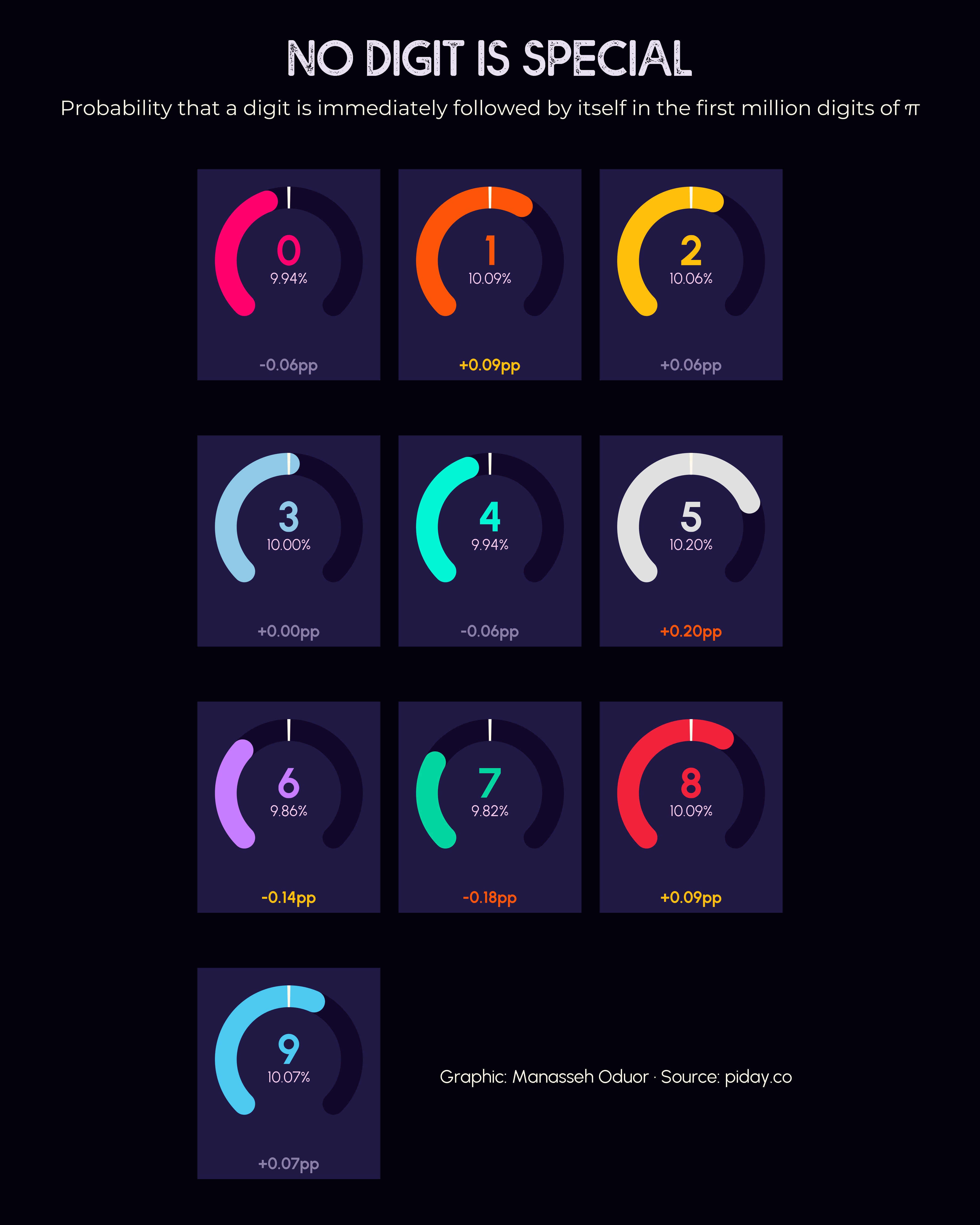
37One way to look for hidden structure is to ask: given that we just saw digit i38, how often is the next digit also i? 39If π behaves like fair dice, this “self-transition rate” should be 10% for every digit. 40The largest is 5 → 5 at 10.195%; the smallest is 7 → 7 at 9.821%. 41Every diagonal entry sits within ±0.20 percentage points of the 10% target — the binomial 95% CI half-width for ~100k trials is ±0.19pp.
6
P(i → i) for each digit. 42Bars centered at 10%; the visible range is [9.7%, 10.3%]. 43No digit prefers or avoids itself meaningfully.
44The original TidyTuesday hero figure shows exactly this: ten gauge dials, one per digit, all hovering around 10%. 45Stare at it as long as you like — there's no sticky digit, no avoidant digit, no detectable autocorrelation at lag 1.
1446Reference: Manasseh Oduor's original TidyTuesday submission (2026 week 12).
47edt_03 · The 10×10 matrix
0348100 numbers, all the same
49Push the test one step further. 50Compute every conditional probability P(next = j | current = i51) — a 10×10 matrix of 100 numbers. 52The full chi-squared on length-2 strings: 94.21 with 99 degrees of freedom, 53p = 0.617. 54Critical value at α = 0.05 is 123.23. 55Once again: the data fails to reject independence with room to spare.
56The single most-frequent two-digit transition is "94" with 10,239 occurrences (1.0239%). 57The least-frequent is "12" at 9,721 (0.9721%). 58The full range across all 100 transitions is just 518 counts. 59As a heatmap, the matrix is visually a flat sheet of pale color. That's the result.
5
60Conditional probability P(next = j | current = i) in percent. 61Diverging color centered at 10.00%; the most extreme deviation is ~0.25pp. 62Hover for exact values.
63Most quantitative findings are interesting because they are uneven. 64This one is interesting because it isn't. 65We tested for hidden structure twice and found two beautifully featureless surfaces.
66edt_04 · The turn
0467The Feynman point — π's one famous misbehavior
Now look at runs68— consecutive identical digits. 69The first three-in-a-row in π is "111" at decimal place 153. 70The first four-in-a-row is "9999". 71The first five-in-a-row is "99999". 72The first six-in-a-row is "999999". 73All three records arrive in one place — decimal place 762 — and the digit setting them is 9. 74This is the famous Feynman point.
8decimal place 76276Where six 9's first appear in a row — the Feynman point.
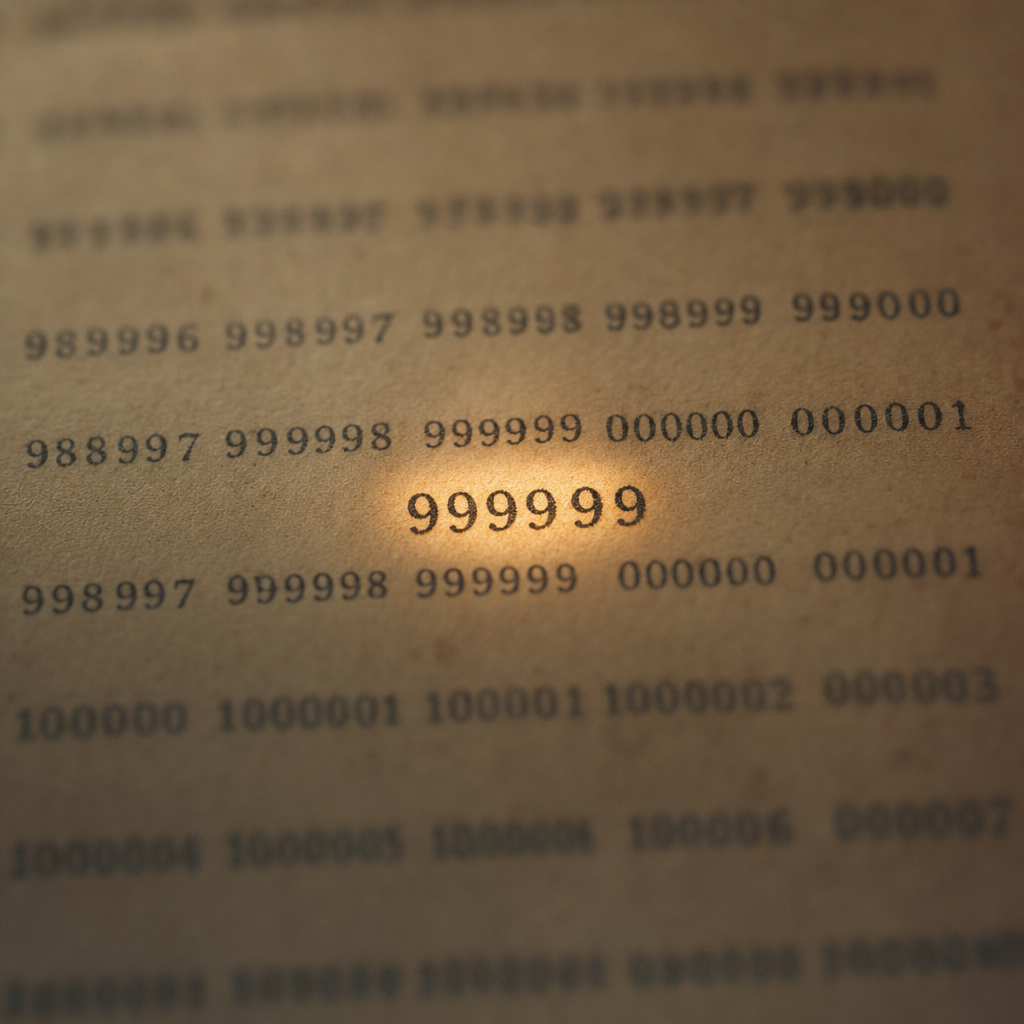
777π's printed digits, with the six-9 cluster catching the lamp light.
78Six 9's appearing this early would happen for a uniformly random sequence about 0.08% of the time. 79The earliest written reference to the joke is Douglas Hofstadter's Metamagical Themas80(1985); the popular attribution to Richard Feynman has never been confirmed in his memoirs or by his biographer.
81The Feynman point is also the only82place in the first million digits where π looks weird. 83Digit 3 catches up later — seven 3's in a row starting at decimal 710,100 — but by then the dataset has long since proven the rule that π is, in every other respect, extremely well-behaved.
84Longest run of each digit in the first million decimals, with where it starts. 85Digit 9 owns the famous Feynman-point run; digit 3 owns the longest run overall.
86edt_05 · The absence
0587The substring that isn't here
88If π contains every possible string somewhere — and most mathematicians believe it does — what about "0123456789"? 89In the first million digits the answer is: it's not there. 90Neither is "9876543210", "123456", "123456789", or even "000000". But we do91find "42" at decimal 92, "666" at 2,440, "0000" at 13,390, "1234" at 13,807, the leading digits of e92(271828) at 33,789, and π reading itself ("314159") at 176,451.
93The textbook answer for "0123456789" is decimal place 9417,387,594,88095— about 17.4 billion in. 96That's roughly 17,400 times deeper than this dataset. 97So the absence isn't a failure of π; it's a feature of one million98— long enough for cute coincidences, far too short for orderly long strings.
9
Where in π?
99This searches a 5,000-decimal window of π (inlined for speed). 100The famous-string table below is the authoritative answer for the full million.
String
What it is
First decimal place
42
101the answer to everything
92
666
"the beast"
1022,440
103999999
the Feynman point
762
1234
four ascending
10413,807
0000
four zeros
10513,390
106271828
107first 6 digits of e
10833,789
109314159
π reading itself
110176,451
111888888
112six 8s
113222,299
114000000
115six 0s
116not in first 1M
117123456
six ascending
118not in first 1M
1199876543210
ten descending
120not in first 1M
121123456789
nine ascending
122not in first 1M
1230123456789
ten ascending
124first appears at digit 17,387,594,880 (≈17.4 billion)
125The "your birthday is in π" parlor trick works ~63% of the time at this depth: 631,548 of all 1,000,000 possible 6-digit strings actually appear in the first million decimals. 126Length-5 coverage is 99.99% (8 missing out of 100,000). 127Length-7 coverage drops to 9.5%. 128The boundary at length 6 is exactly where probability theory predicts.
10
129Fraction of all length-k130strings present somewhere in the first million decimals. 131Observed values track expected probabilities almost exactly.
132edt_06 · Convergence
06133How fast does π converge?
At n134= 10 digits, three of the ten possible digits haven't appeared at all and three others appear twice their share. By n135= 100 the spread is ±4 percentage points. By n136= 10,000 it's about ±0.5pp. By n137= 1,000,000 every digit's running rate sits within ±0.05pp of 10%. 138This is exactly the 1/√n139behavior the Central Limit Theorem promises.
11
140Running per-digit percentage at log-spaced sample sizes n141= 10 → 1,000,000. 142Ten thin lines collapsing onto the 10% horizontal.
143Define "settled" as the smallest n144at which a digit's running percentage stays inside [9.9%, 10.1%] forever. 145Digit 0 settles first, at n146= 25,991. 147The slowest is digit 7, at n148= 368,515. 149By the time we hit 369k digits, all ten have permanently joined the ±0.1pp club.
13
150A 10-second ambient marimba bed — pi's digits as a calm, uniformly distributed soundscape. Optional.
151edt_07 · The close
07152What a million digits can and cannot tell us
153NASA's JPL navigates spacecraft using 15 digits of π. 154Forty digits would compute the circumference of the observable universe to within the width of a hydrogen atom. We have a million.
12155Decimal digits of π, computed and printed — a million is far more than anyone needs, and not nearly enough to settle the open question.
156What that million can do: confirm uniformity at 157p ≈ 0.79158, confirm pairwise independence at 159p ≈ 0.62160, surface every length-5 substring (99.99% coverage), find the Feynman point at decimal 762, and watch each digit's running frequency converge to 10% on a 1/√n schedule. 161What it cannot do: prove π is normal, find runs of seven or more identical digits other than the one stray "3333333", or fit "0123456789".
162π is a number we know exactly. 163Its digits behave as if we don't. 164That's the whole story — and the unsolved problem at the center of it is older than any of us, and probably will outlive most of what we'll ever write.