




The space race is dominated by new contenders
Private businesses and rising powers are replacing the cold-war duopoly
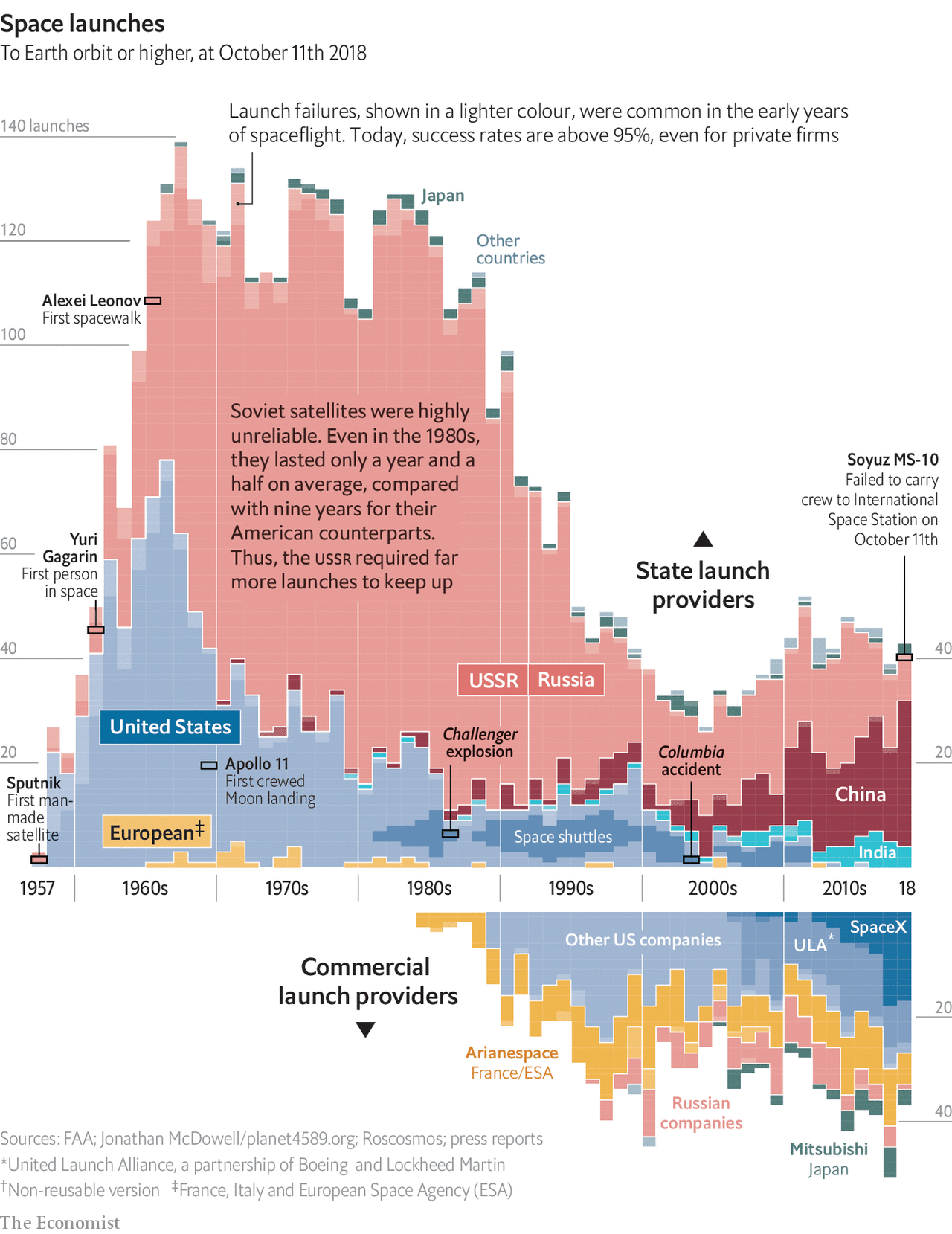
SOME 4,500 satellites circle Earth, providing communications services and navigational tools, monitoring weather, observing the universe, spying and doing more besides. Getting them there was once the business of the superpowers’ armed forces and space agencies. Now it is mostly done by companies and the governments of developing countries.
During the early years of the space race reaching orbit was hard. Between 1957 and 1962, 32% of American launches and 30% of Soviet ones failed. Accidents still happen: on October 11th a Russian rocket aborted its ascent shortly after launch (both crew members landed unharmed). Only states could assume such risks—and even if American firms had wanted to bear them, its government would not let them on national-security grounds. Companies eager to send objects into space, including telecoms firms, had to hitch a ride with NASA.
This changed when European countries started building launchers through a mostly state-owned company called Arianespace, which touted for custom among satellite-makers around the world. When the space shuttle Challenger exploded in 1986, NASA got out of the satellite-launching business. It and, later, the Pentagon became new customers for private launch firms, alongside the satellite operators.
In the past decade the West’s space-launch market has become more competitive thanks to an innovative new entrant, SpaceX. But state-run programmes still lead the way in emerging markets. In 2003 China became the third country to put a person into orbit; India plans to follow suit in 2022. Both sell launch services to private clients. China did legalise private space flight in 2014, but no companies based there have yet reached orbit on their own.
Like their cold-war predecessors, these Asian titans have strategic goals as well as a thirst for publicity. They need independent access to space for communication, intelligence and navigation. However commercialised space gets, the competition will never be solely economic.
Sources: FAA; Jonathan McDowell/planet4589.org; Roscosmos; press reports
Get the data
Explore more
This article appeared in the Graphic detail section of the print edition under the headline “The next generation”
From the October 20th 2018 edition
Discover stories from this section and more in the list of contents
Explore the edition
Handpicked stories, in your inbox
A daily newsletter with the best of our journalism
Labour faces a drubbing in England’s local elections
The party could lose more than half of the council seats it is defending

The war in Iran has sent American inflation sharply higher
Our predictive index has reached a sizzling 3.6%
Why eldest siblings are brainier
A new study finds that sickness may play a role
Even Hungary’s skewed elections might not save Viktor Orban
The ruling party is playing dirty. But our analysis shows the liberal opposition has a real chance of winning
Global democracy is in better shape than you think
EIU’s annual index suggests an end to the democracy recession
Donald Trump’s approval rating has sunk to Joe Biden’s lowest point
He is mirroring his predecessor’s post-debate slump of 2024